Walk down any pest control aisle and you will see a confusing mix of options: glue boards, live‑catch cages, wooden snap traps, enclosed tunnels and high‑tech electric devices. For a homeowner simply wanting the rats gone, it is not always obvious which route to take. Yet from a welfare, safety and effectiveness perspective, some options are clearly better than others. Understanding the pros and cons of each will help you choose the best rat trap for your home rather than wasting money or causing avoidable suffering.
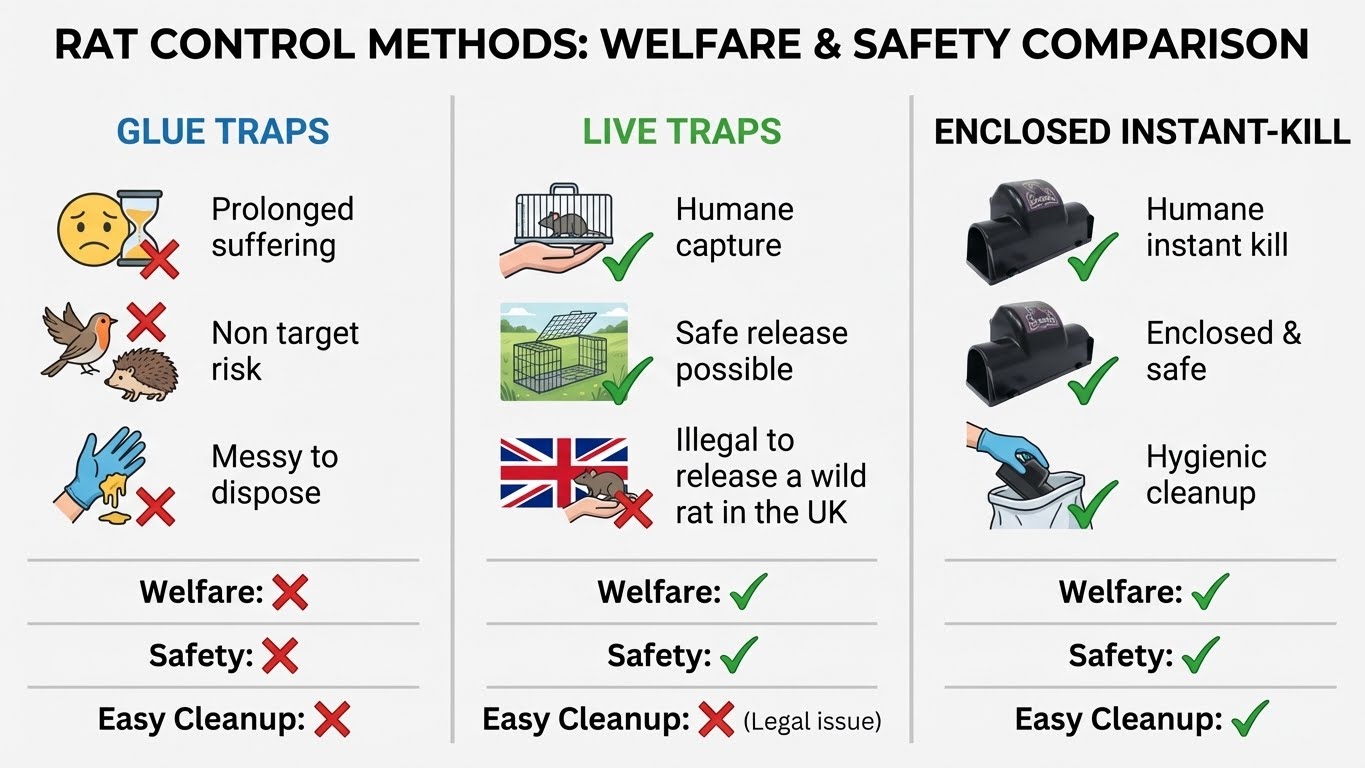
Glue traps are often marketed as a simple, low‑cost solution, but they are among the most controversial tools in modern pest control. When a rat or mouse runs over the board, it becomes stuck and struggles to escape, often injuring itself in the process. Scientific reviews have documented rodents becoming fully entangled, with feet, body and head stuck, mouths glued shut, fur torn away and raw skin exposed. Animals frequently remain alive for many hours, panicked and distressed, defecating and urinating as they try to break free. Humane organisations and veterinary associations increasingly regard glue traps as inhumane, recommending that they should not be used except under exceptional circumstances, if at all. For most domestic situations, they are neither the best rat trap nor an ethically defensible one.
Live‑capture cages are sometimes seen as a kinder option, because they do not kill the animal immediately. The idea is that you trap the rat, then release it somewhere else. In practice, live trapping raises its own welfare and practical issues. Cages must be checked frequently to avoid leaving animals without food or water, exposed to extreme temperatures, or vulnerable to predators. Released rats may struggle to survive in unfamiliar territory or simply return, and relocation can spread disease and infest new areas. Many humane control guidelines suggest that if rodents must be removed, killing them quickly and cleanly is often preferable to prolonged stress or poorly managed relocation.

Traditional snap traps, when well‑designed and correctly set, can kill very quickly by striking the neck or skull, causing rapid loss of consciousness and death. However, poor‑quality traps, incorrect placement or mis‑setting can lead to partial catches where the animal is injured but not killed outright, resulting in pain and suffering. Exposed traps also pose a danger to pets and children, who may accidentally trigger them and be injured. For these reasons, guidance often recommends that snap traps be placed inside protective boxes or housings when used in homes like kitchens or outdoors.
Modern enclosed instant‑kill traps are designed to address these shortcomings. Devices like tunnel‑style traps or lockable enclosed units house a powerful internal mechanism inside a plastic or metal shell, with small entrances sized for rodents. This design prevents pets, children and most non‑target wildlife from accessing the striking parts, while keeping the kill zone dark and tunnel‑like to encourage rodents to enter. When they step onto the trigger plate, a strong snap mechanism or electronic discharge kills them rapidly, and the body remains hidden inside the casing for hygienic disposal.
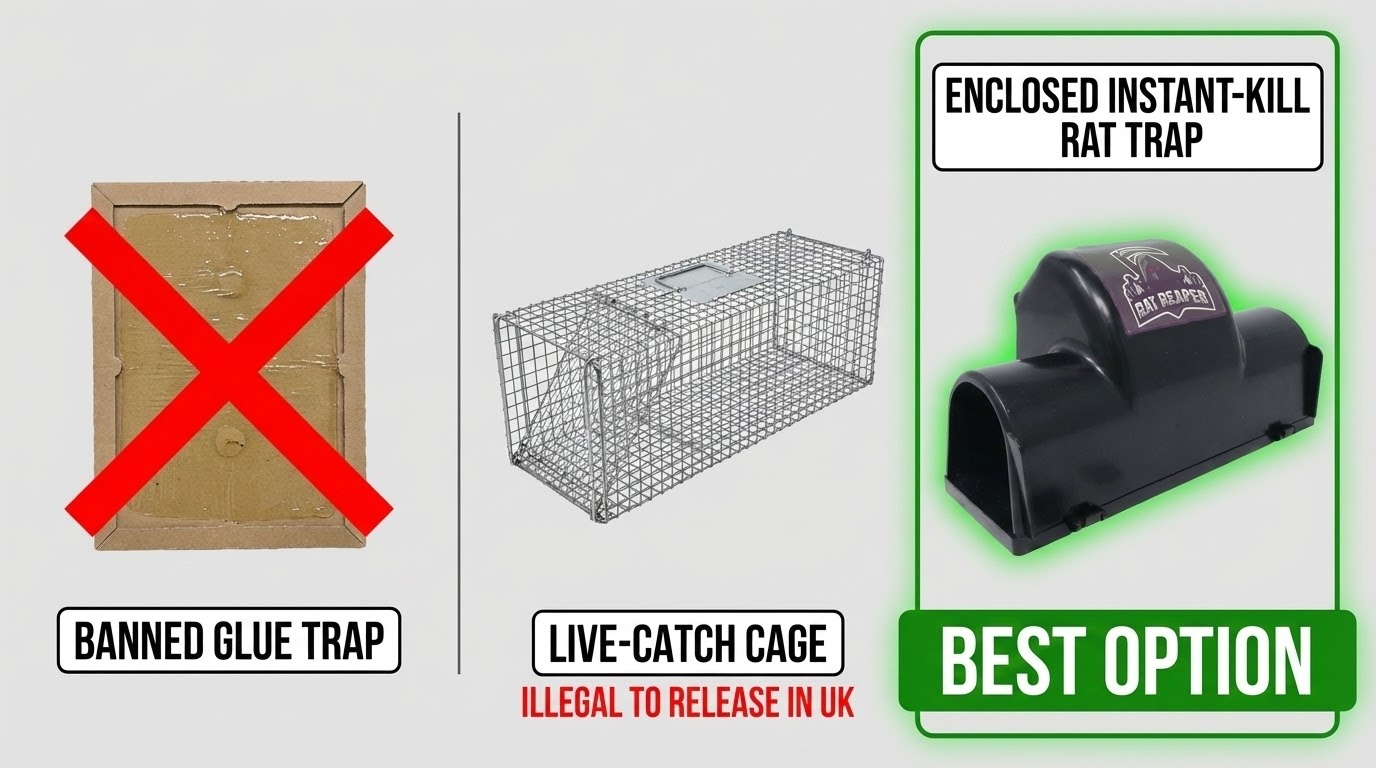
From a welfare perspective, well‑made instant‑kill traps are among the most humane lethal options currently available, especially compared with glue boards or slow‑acting poisons. From a safety standpoint, enclosed designs dramatically reduce risks to non‑target animals and people, and they also simplify clean‑up, as there is no need to touch the carcass directly. When paired with effective bait, careful placement along runways and regular monitoring, these traps provide a practical, targeted and ethically defensible way to manage rats in domestic environments.
For homeowners weighing up glue traps, live cages and various types of snap devices, the best rat trap is the one that balances fast, reliable kills with strong safety and welfare credentials. Glue traps and poorly used live traps fall short on welfare; exposed snap traps fall short on safety. Enclosed instant‑kill traps, such as Rat Reaper, bring together the benefits of mechanical control—speed, certainty and the absence of poison—with a modern housing that protects pets, children and wildlife. In a world where people increasingly care how problems are solved, not just that they are solved, this approach makes far more sense than outdated, cruel or risky alternatives.